
Rio Tinto urged to accelerate action on remediation of Panguna mine
Bougainville News
One year on from the release of an independent investigation into Rio Tinto's former Panguna mine in Bougainville, communities living with the ongoing environmental impact are calling on the company to urgently move towards funding solutions, particularly in areas identified as posing life-threatening risks.
Conducted by Tetra Tech Coffey, the Panguna Mine Legacy Impact Assessment found serious risks to local people from toxic chemical hazards, collapsing infrastructure and levees, and mine-related flooding.
The report made over 30 recommendations for action to address the hazards and other significant impacts on communities caused by over a billion tonnes of tailings waste left by the mine.
Traditional Owners of the area and supporters from the Human Rights Law Centre noted in a statement on Friday that since the report's release, Rio Tinto has accepted its findings and committed to developing a remedy mechanism consistent with the UN Guiding Principles on Business and Human Rights.
"Over the past year, the company has been working with communities, the Bougainville Government and its former subsidiary, Bougainville Copper Limited, to discuss ways forward, and has supported further investigations into some of the most critical risks posed by the mine," the statement read.
"Despite these steps, leaders from affected communities have expressed concerns at the slow pace of progress towards addressing time-critical risks on the ground, some of which were first identified as early as August 2022.
"Communities are urging Rio Tinto to now move decisively towards addressing the mine's impacts and establishing an independent fund for long-term remediation works and clean-up."
'Our people cannot wait indefinitely; too much is at risk'
Theonila Roka Matbob, traditional landowner and lead complainant, said residents were still at risk.
"A year on from the release of the report, our communities are still living with collapsing levees, polluted rivers, and dangerous chemicals. The mine's impacts affect every aspect of our daily lives; from where we grow our food and collect our water to our ability to safely cross rivers to access schools and healthcare," she said.
"The Impact Assessment confirmed the scale and severity of the disaster we are living with and highlighted many areas where people's lives are at risk. We acknowledge Rio Tinto for coming to the table with communities and the company's support for this process so far. What we need now is for solutions to be implemented quickly, in partnership with community leaders on the ground.
"Our people cannot wait indefinitely; too much is at risk. We urge Rio Tinto to now move quickly towards action to remedy the huge problems we are facing due to the mine".
In March, Bougainville community leaders called for representation in discussions over the potential remediation of the former Panguna mine, which began in Port Moresby that month.
At the time, Ms Roka Matbob said community leaders "find ourselves shut out of the room".
"This is not the way to rebuild trust with communities or design lasting solutions," she said.
'An ongoing environmental and human rights disaster'
Human Rights Law Centre legal director Keren Adams said on Friday that the Impact Assessment confirmed in "unequivocal terms" that communities in Bougainville are "living with an ongoing environmental and human rights disaster".
"It found major impacts in every area assessed, including many life-threatening risks to communities," she said.
"We welcome Rio Tinto's public commitment to working with all stakeholders towards lasting solutions. Communities now need to see that commitment translate into tangible action on the ground to address risks and impacts identified in the report, and the establishment of an independent fund for clean-up and remedy, as they have repeatedly called for.
"Rio Tinto's new leadership team have an important opportunity to move decisively to address the company's legacy at Panguna and to rebuild trust with the people of Bougainville."
A Rio Tinto spokesperson told National Indigenous Times the Panguna Mine Legacy Impact Assessment was "a critical step forward in building understanding of the long-term legacy impacts of the former mine in Bougainville".
"Throughout 2025, we have continued to engage with the PMLIA Oversight Committee, and the Autonomous Bougainville Government (ABG) and Bougainville Copper Limited (BCL) through a Roundtable, to identify ways forward and key priority actions," they said.
"Ongoing and continuing efforts by the Roundtable parties to address high and very high saliency impacts and imminent risks include: works on 4 structural sites that pose severe and imminent risks to nearby communities; removal of hazardous materials associated with a risk to life from Loloho Port; works to address the impact of flooding for Kuneka Creek communities; geo-technical monitoring and hazard awareness campaigns to ensure local communities and small-scale miners are made aware of potential risks; and additional investigations to address the most critical impacts identified in the PMLIA.
"We continue to support a water and sanitation project in Central Bougainville, in cooperation with the ABG, providing drinking water facilities and youth training to communities."
A troubled history
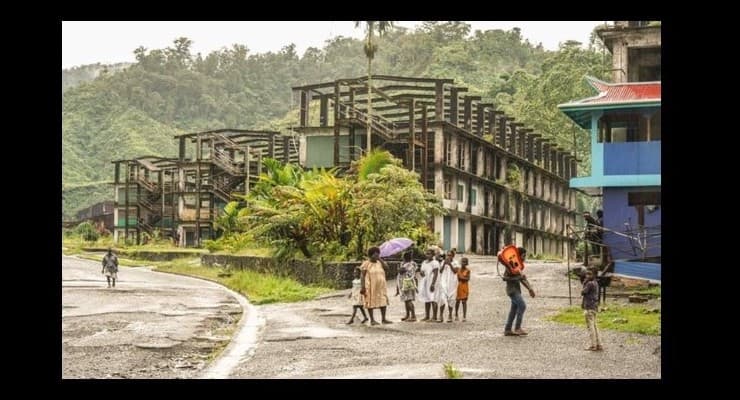
Panguna was previously one of the world's largest copper and gold mines. During its operation from 1972 to 1989, over a billion tonnes of mine waste was released directly into the Jaba and Kawerong rivers.
In 1989, an uprising by local people against this environmental destruction and inequities in the distribution of the mine's profits forced the mine to stop operating and triggered a brutal decade-long civil war.
Rio Tinto remained the majority owner of the mine until 2016, when it divested and passed its shares to the PNG and Bougainville governments. No clean-up has ever been undertaken of the site.
The company agreed to fund the Panguna Mine Legacy Impact Assessment in 2021 in response to a human rights complaint brought by local communities, represented by the Human Rights Law Centre.
Phase 1 of the Impact Assessment, published in December 2024, confirmed extensive impacts and risks for local people are being caused by the abandoned mine, including: imminent, life-threatening risks posed by the collapsing mine pit, levees and infrastructure; ongoing contamination of the Jaba and Kawerong rivers and migration of waste into new areas; mine-related flooding, making river-crossings to access basic services life-threatening and affecting peoples' access to drinking water, food gardens and sacred sites; and toxic chemicals stored in some locations and found in the soil in some areas.