
Forestry Sector Money Laundering Risk Assessment presents a devastating picture of corruption
A Money Laundering Risk Assessment for the Forestry Sector published by the Bank of Papua New Guinea presents a devastating picture of large-scale corruption, fraud and illegality in the logging industry.
The report identifies five high risk factors for money laundering in the forestry sector:.
1. HIGH RISK: Corruption of politicians and public servants
The report finds corruption is a significant issue in the forestry sector in PNG and details cases dating back to the 1989 Barnett Commission of Inquiry involving Ministers, Provincial Governors and corrupt government officials granting improper permits, abusing due processes and violating environmental standards and resource ownership rights., Corruption has also been linked to forced labour and sex trafficking.
Yet, despite corruption being a major driver of illegal practices in the forestry industry, the report notes there have been no criminal prosecutions of politically exposed persons.
PNG Forest Authority, PNG Customs Service and the police are identified as the agencies most vulnerable to corruption.
“Given their critical role in enforcing law against illegal activities in the forestry sector – and the potential of corruption in their operations – illegally generated proceeds within the forest industry may go undetected and are likely to be laundered domestically or abroad.”
2. HIGH RISK: Tax evasion and laundering proceeds through offshore jurisdictions
The Risk Assessment highlights strong indications that the logging industry in PNG is evading tax by failing to declare significant income from log exports with illegal proceeds being laundered offshore through Singapore, Hong Kong, Malaysia as well as domestically.
3. HIGH RISK: Transfer pricing and financial fraud
Transfer pricing is another high risk factor for money laundering in the forestry sector. Logging companies declare an artificially low selling price for logs exported from PNG, while receiving a much higher price from buyers overseas. This allows logging companies to again evade paying taxes in PNG
4.HIGH RISK: Investment of funds derived from corruption
The report finds a high risk of money laundering by politicians and public servants who are actively engaged in partnerships and business activities alongside logging company shareholders and managers.
5. HIGH RISK: Logs harvested outside concession areas
The Risk Assessment details legal cases where logging permits have been declared null and void due to violation of the requirements of the Forestry Act. These cases provide clear evidence some logging activities are being carried out without proper legal authorisations - such as valid timber timber permits, timber authorities, forest clearing authorities or licences.
The report estimates that between 2014-19 PNG lost US$2 billion (K8.7 billion) in foreign currency inflows and taxable revenues through transfer pricing alone. This loss was identified through an unexplained discrepancy in official government reporting between the value of logs exported from PNG and the recorded value of the same logs when imported into China.
Just as disturbing is the finding that National Court rulings that have declared timber harvesting licences null and void for violation of the Forestry Act have been ignored and logging allowed to continue. These voided projects include both Forest Clearing Authorities and Timber Permits.
In one instance says the report, after an a large FCA project was declared void the area continued to suffer significant deforestation even though no log exports were recorded in official monitoring reports. In another area, after the FCA was declared null and void, logging continued and over 11,000 cubic metres of logs were exported.
In another case, Timber Permits that had expired in 2007 and 2008 were extended and given to another logging company in 2017 in violation of the Forestry Act.
The Risk Assessment also identifies a further seven forestry related activities that are rated as a medium / high risk for money laundering.
These are:
- Criminal activities committed abroad and related illicit funds used as capital investments in logging companies in PNG
- Logging operations illegally continuing after concessions have expired
- Unaccounted shipments of logs leaving PNG without proper clearance
- Criminal activities committed abroad and related illicit funds used as capital investments in oil palm companies in PNG
- Use of foreign employees as cash couriers to smuggle currency out of PNG
- Misuse of Forest Clearing Authorities with no agriculture, economic or other land use activities developed
- Mis-declaration of species and quantities of logs
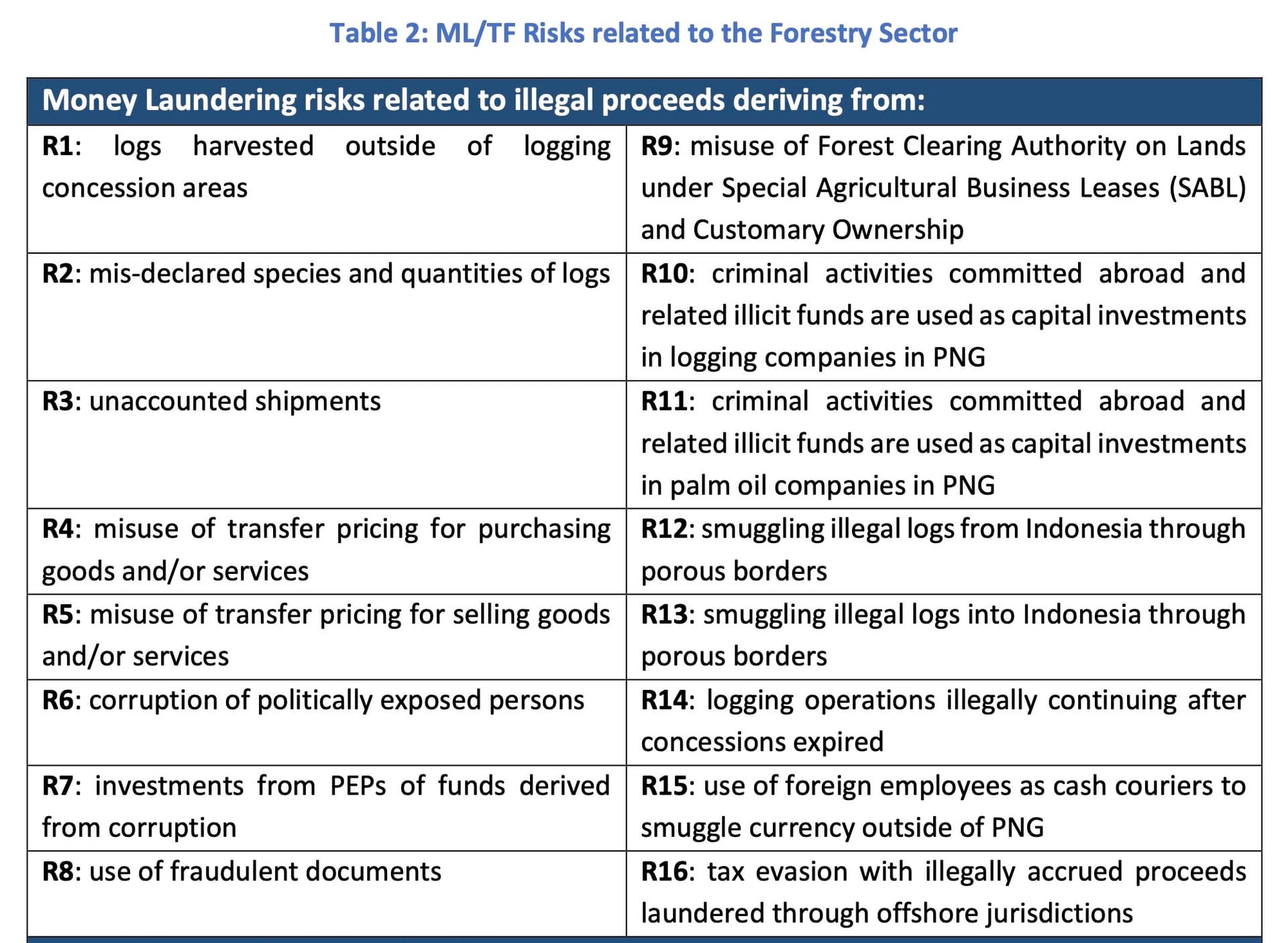
In total the Risk assessment identifies sixteen money laundering risks relating to illegal proceeds derived from forestry related activities
The Risk Assessment identifies a series of actions to be taken by government agencies to mitigate the identified money laundering risks.
These include internal corruption risk assessments to be carried out by the PNG Forest Authority, Customs Service and police, establishment of a multidisciplinary approach for criminal investigation of money laundering in the forestry sector and enforcement of the Proceeds of Crime Act to seize and confiscate illegal proceeds from forestry crimes.
Although dated October 2020, the Forestry Sector Risk Assessment was only published in November 2025 because of delays caused by PNG Forest Authority concerns about many of the report findings - concerns that are documented in the report footnotes.
The published report is described as a “sanitized version” of the original in which confidential and sensitive information has been “redacted or restructured for public release”.